

Cloud-Based School ERP: Why Your School Should Switch!
-
 By Emmanuel W.
 - Operations
- Jan 08, 2026
- 5 minutes read
- 483 Views
Most schools do not wake up one morning and decide to implement an ERP system. The decision usually comes after a series of recurring frustrations.
Admissions records do not align with fee data. Parents call for updates that staff cannot access instantly. Reports take days to compile. Attendance is recorded in one system, exams in another, and staff records somewhere else entirely. Over time, it becomes clear that the systems holding the school together are no longer efficient enough to support daily operations.
That is typically when schools begin exploring School ERP solutions. Soon after, they encounter a newer concept: cloud-based School ERP. It sounds modern and, for some, slightly intimidating. The real question then becomes whether switching is truly worthwhile or simply another technology trend.
This guide helps you evaluate that decision clearly—through the lens of EduWise School ERP.
What Is a School ERP and Why Move It to the Cloud?
At its core, a School ERP is a single, unified platform that connects all administrative and academic functions of a school. Admissions, student records, attendance, examinations, fees, staff management, and communication operate within one system rather than across disconnected files, registers, and software.
The goal is not to make schools “high-tech.”
The goal is to make everyday work less chaotic and more predictable.
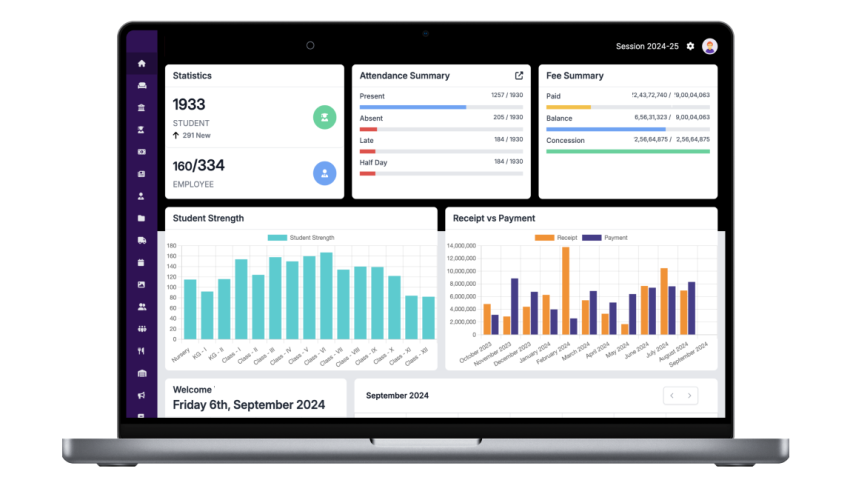
A cloud-based School ERP like EduWise operates entirely online. There is no local server to manage and no dependency on a single computer within the school office. Authorized users simply log in through the internet.
Teachers update attendance, and it reflects instantly
Administrators access real-time data without manual syncing
Parents view information without waiting for office hours
Most importantly, the school does not manage the technical infrastructure.
Updates, backups, system maintenance, and security are handled by EduWise in the background.
Traditional (On-Premises) ERP Systems in Schools
Traditional ERP systems are installed directly on school premises. The school owns and maintains the server, manages updates, and depends heavily on IT support. Access is often restricted to the school network unless additional configurations are made.
While this model offers control, it also comes with responsibility:
Hardware failures become the school’s problem
Software updates require planning and downtime
Scaling the system as student numbers grow becomes expensive
Many schools reach a point where the ERP exists, but no longer supports how the institution actually operates. That is when limitations become visible.
Cloud-Based ERP vs Traditional ERP
| Aspect | Cloud-Based ERP (EduWise) | Traditional ERP |
|---|---|---|
| Accessibility | Anywhere, anytime | Limited to school premises |
| Setup | Fast and simple | Time-consuming |
| Maintenance | Managed by provider | Managed by school |
| Updates | Automatic | Manual |
| Scalability | Easy and flexible | Costly and complex |
| Initial Cost | Lower | Higher |
| IT Dependency | Minimal | High |
For many schools, this comparison alone is enough to seriously consider the cloud.
Why More Schools Are Choosing Cloud-Based ERP
The move to cloud ERP is rarely driven by excitement. It is driven by relief.
Relief from managing backups.
Relief from frequent IT issues.
Relief from systems that only work when staff are physically on campus.
Cloud-based ERP aligns better with how modern schools function. Administrators manage growing compliance requirements, teachers work beyond classroom walls, and parents expect immediate access to information. Systems limited to physical locations increasingly feel outdated.
There is also a long-term benefit that becomes clear over time: consistency.
When everyone works on a single live system, data mismatches reduce, processes stabilize, and decisions are made using current—not outdated—information.
Does Cloud ERP Make Sense for Small Schools?
This is where cloud ERP has quietly changed the landscape.
Previously, ERP systems were complex and financially out of reach for smaller schools. Cloud-based models introduced subscription pricing, simpler onboarding, and minimal IT dependency—making ERP adoption realistic for small and mid-sized institutions.
For larger schools and school groups, the value lies in centralized control, standardized processes, and visibility across multiple branches. EduWise is designed to support both ends of this spectrum.
The Cost Question Schools Always Ask
Cloud-based ERP systems typically operate on a recurring subscription model, which can initially raise concerns. However, the total cost picture tells a different story.
Traditional ERP requires investment in servers, hardware, licenses, ongoing maintenance, and IT personnel. These costs often arise unexpectedly.
EduWise spreads costs predictably, eliminates heavy upfront investment, and includes services that schools would otherwise manage independently. For many institutions, cost predictability alone simplifies financial planning.
Which Schools Should Consider Switching?
Schools should consider moving to a cloud-based ERP if:
Administrative workload increases every year
Parents rely heavily on phone calls for basic information
Reports take too long to generate
Data across departments does not always align
Schools planning growth, expansion, or stronger parent engagement benefit the most. Even schools with existing ERP systems often switch when their current setup no longer matches how they operate.
The most significant change is not technological—it is time.
Routine tasks become simpler. Information becomes easier to access. Follow-ups reduce. Over time, operations run with less friction.
It is not dramatic.
It is practical.
Why EduWise School ERP?
EduWise School ERP is built to make cloud-based school management practical in real environments—not just impressive on paper.
The system is designed to:
Simplify administrative operations
Reduce technical dependency
Improve data accuracy and visibility
Support schools as they grow
Schools interested in understanding how cloud ERP fits into their daily operations can explore EduWise through a free demo.
Conclusion
Switching to a cloud-based School ERP is not about following trends. It is about choosing a system that supports the school rather than slowing it down.
For many institutions, the cloud simply removes obstacles that should not exist in the first place. Once those obstacles are gone, schools can focus on what truly matters—running the institution effectively and delivering quality education.
Emmanuel W.
Leave a comment
Your email address will not be published. Required fields are marked *